

Tree Risk Assessment
An arborist reads the tree, names what he finds, and tells you whether it needs to come down or not.
A Tree Risk Assessment Before You Decide the Tree Has to Go
A big tree close to the house is either an asset or a liability, and from the ground it is hard to tell which. Garth Landis is one of the three owners of this company, and he writes the tree care guides on this site. A certified arborist is who comes out. Plenty of trees people are ready to cut down turn out to be sound. We do not cut a tree that does not need cutting.
They took two huge trees out of our backyard in a tricky, hard to reach spot with no trouble at all.
Kim G. • Google review, 2020

Trunk Cavities, Cracks and Fungus, the Early Signs of Decay
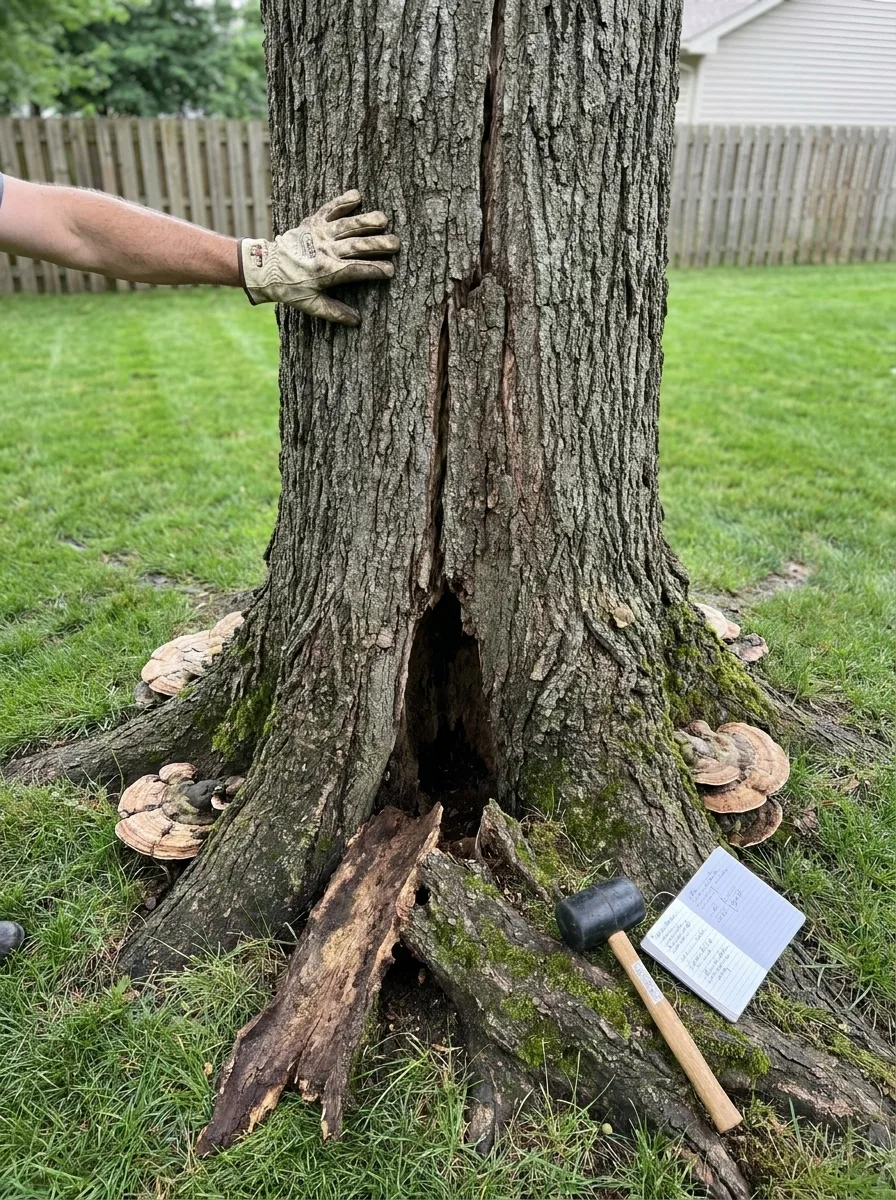
A cavity is not automatically a death sentence, and a small mushroom at the base sometimes is. What matters is how much sound wood is left in the shell and where the load sits. That is a judgment an arborist makes on site, not something you can read off a photo.
Root Damage After Trenching, Grading or a Wet Year
Most tree failures start underground. A trench for a line, a driveway widened three years ago, fill dumped over the root plate, or a saturated spring can undercut a tree that still looks fine up top. Your arborist checks the root collar, the soil and the lean together.
Emerald Ash Borer, Oak Decline and the Pests That Follow Them
Emerald ash borer has taken ash across the Roanoke Valley, mature oaks decline from the top down, and Dutch elm disease still moves through elms here. Naming the disease matters, because it tells you whether the tree can be treated, whether it is going to spread, and how long you have.
Years in the Roanoke Valley
Better Business Bureau
Estimate, every job
How Your Arborist Inspects a Tree and What You Get Back
1. An Arborist Walks the Whole Property, Not Just the One Tree
The tree you called about is usually not the only one worth looking at. The walk covers everything within reach of the house, the drive and the lines.
2. He Checks Structure, Roots, Soil and Terrain Together
He reads lean, crown condition, attachment points, decay, root collar, soil and slope. On a ridge lot, terrain does half the work of predicting how trees fail.
Get My Free EstimateThey honored their estimate quote that was over a year old.
Healthy in Heart • Google review, 2021
Recent Tree Jobs, Finished and Cleaned Up
See jobs near you.
Tree Risk Assessment
The trunk came down hollow all the way through

Emergency Tree Service
Storm-uprooted trunk resting against the house

Tree Trimming & Pruning
Climber taking a long limb off a hillside hardwood
Tree Service Reviews From Homeowners
These gentlemen have done tree work for me over the past 20 years... they are thoroughly honest and reliable and they show up to work when they say they will.
Mary Justice • Google review, 2022
Jeff, Garth, and their team of guys worked very hard on removing this tree. They were all very nice and professional, in spite of this challenging job.
Amanda Earls • Google review, 2021
Before you call
Do you charge for the assessment?
The estimate for tree work is free. A full written risk assessment is its own service with its own price, because it is arborist time and a written opinion, not a sales visit. If what you want is a number for taking the tree down, that walk stays free. Pay for the assessment when you need the finding and the reasoning written out rather than a price.
Can you tell from a photo?
Sometimes for the obvious cases, never for the important ones. Decay and root problems do not photograph. Send photos anyway, they help your arborist know what to bring. A cavity looks alarming in a picture and can be sound. A tree with nothing showing at all can be hollow up the middle, or standing on roots a trench cut three years ago. Those are the ones a photo will not catch.
What does the arborist actually check?
He reads the whole tree in one pass. The crown for deadwood and lopsided load, the trunk for cracks, cavities and fungal conks, the union where two stems meet, and the root collar at the base, which should flare out rather than enter the ground like a post. Then the soil, the lean and the terrain together, because most failures start underground and a ridge lot changes how a tree comes apart.
What do I get at the end of it?
A plain-English report and a recommendation, with no jargon to look up. He says what he found, what it means, what he would do about it and what that takes. If the answer is pruning instead of removal, that is what the report says. It comes to you in writing, so it is still in your hands when you decide, and so is the reasoning behind it.
My neighbor's tree is leaning over my roof. Can you assess that?
An arborist can inspect what is on your property and give you a written opinion on what is threatening it. Who does the work, and who pays, is between you, your neighbor and the insurers. J&J does not take a side in that and does not give an opinion on liability. The report names what is wrong with the tree and what it stands over, which is a more useful thing to hand a neighbor than an argument.
More about tree risk assessment in Roanoke, VA
What arborists look at above ground during a Roanoke, VA tree risk assessment
- Dead limbs up in the top, because those fall first, and what stands below them in a Roanoke, VA yard makes them hazardous.
- The shape of the crown, since a lopsided top loads one side, and that load is the risk arborists are measuring on the tree.
- Old topping cuts, because regrowth off those stubs attaches weakly and is usually the first part of the tree to fail.
- Cracks and seams running down the trunk, which show the tree has already moved under load and raise the risk.
- Cavities and hollows, where the assessment turns on how much sound shell is left, not on how large the hole looks.
- Fungal conks on the trunk or the limbs, since those point to decay and to diseases already at work inside the tree.
- Included bark at a union, where two stems press together instead of joining, which is where trees commonly fail.
- Which way the tree leans, and whether it grew that way or started recently, because those carry very different risk.
What arborists look at below the trunk during a Roanoke, VA tree risk assessment
- The root collar, which should flare at the base, because a trunk entering the ground like a post is what arborists flag on healthy trees.
- Whether soil or mulch is piled against the base, because a buried collar decays out of sight and leaves the tree hazardous.
- The root plate, and whether ground on the uphill side has lifted or cracked, which arborists treat as an urgent finding.
- Roots cut by trenching, grading or a new drive, because roots taken off one side change what holds the tree up.
- Soil conditions at the base, since compacted or saturated ground holds roots less well, and that goes in the estimate and the assessment.
- Mushrooms at the base, which can mean root decay and diseases below even while the top of the tree still looks healthy.
- Site history around Roanoke, VA, because grading, fill and construction near the roots explain more decline than anything visible above.
- What stands within reach if it fails, homes or a drive, because a Roanoke, VA risk assessment weighs the target as well.
Request a free tree estimate
Thanks. An arborist will call you back about the tree.
That did not send. Please call (540) 588-8832 instead.

Ready to Get That Tree Handled?
Talk to a certified arborist who owns the company. Free estimates across the Roanoke Valley, and we haul off every limb before we leave.
The crew runs out of Moneta and works the Roanoke Valley daily.